
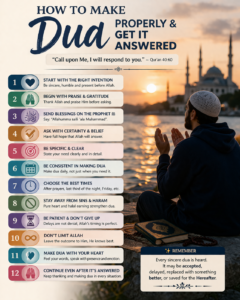
How to Make Dua Properly and Get It Answered
Introduction: When You Feel Like Your Dua Isn’t Being Answered
Let’s be real for a moment.
Almost everyone has had this feeling at some point:
You raise your hands.
You ask sincerely.
You repeat the same dua again and again.
But nothing seems to change.
And slowly, a thought creeps in:
“Is my dua even being heard?”
If you’ve ever felt this way, you’re not alone.
But here’s what you need to understand clearly:
No sincere dua is ever ignored.
The issue is not whether Allah hears you.
The real question is: Are we making dua the way it should be made and understanding how it gets answered?
Let’s break this down properly.
Also Read: How to Maintain Respect and Peace in Marriage
What Dua Really Is
Dua is not just asking.
It is:
- An act of worship
- A direct conversation with Allah
- A sign of your dependence on Him
When you make dua, you are doing something powerful:
You are admitting that you need help and only Allah can give it.
That alone is عبادah.
Why Some Duas Feel Unanswered
Before learning how to make dua properly, we need to fix a common misunderstanding.
Dua is answered in three ways:
- You get exactly what you asked for
- Something better is given instead
- Harm is removed from your life
- Reward is saved for the Hereafter
So sometimes, the answer is happening, but not in the way you expected.
Step 1: Start With the Right Intention
Dua is not a transaction.
It’s not: “I ask, I get.”
It’s about connection.
When you make dua:
- Be sincere
- Be honest
- Be present
Don’t rush through it like a routine.
Step 2: Begin With Praise and Gratitude
Before asking for anything, start by:
- Praising Allah
- Thanking Him
Why?
Because it shifts your mindset from: “I don’t have enough”
To: “I’ve already been given so much”
Gratitude opens the door to acceptance.
Step 3: Send Blessings Upon the Prophet
This is a powerful step many people overlook.
Sending blessings increases the chances of your dua being accepted.
It also brings barakah into your supplication.
Step 4: Ask With Certainty
This is important.
When you make dua, don’t think: “It probably won’t happen.”
Ask with:
- Confidence
- Hope
- Belief
Because doubt weakens your connection.
You’re asking the One who can do anything.
So ask like you believe it.
Step 5: Be Specific in Your Dua
Don’t just say: “Make my life better.”
Be clear.
For example:
- Ask for specific guidance
- Ask for specific outcomes
- Ask for clarity in decisions
The more specific you are, the more focused your dua becomes.
Step 6: Be Consistent, Not Occasional
One of the biggest mistakes people make is:
They only make dua when they need something.
Then they stop.
Dua should be:
- Daily
- Regular
- Consistent
Even when things are going well.
Consistency builds connection.
Step 7: Choose the Best Times
Timing matters.
Some moments are more powerful for dua:
- After obligatory prayers
- During the last third of the night
- Between اذان and اقامة
- On Fridays
Use these moments.
They are opportunities.
Step 8: Avoid Sins That Block Acceptance
This is something many people ignore.
Certain actions can affect your dua:
- Earning haram income
- Living in constant disobedience
- Ignoring obligations
This doesn’t mean your dua won’t be heard.
But it can delay or affect acceptance.
Step 9: Be Patient—This Is Where Most People Fail
This is the hardest part.
People make dua for:
- Days
- Weeks
- Months
And when they don’t see results, they stop.
But patience is part of the process.
Delays are not rejection.
Sometimes:
- Timing is not right
- You are being prepared
- Something better is coming
Step 10: Don’t Limit Allah
Sometimes we make dua—but we limit how it can happen.
We think: “It has to happen this way.”
But Allah can:
- Change situations
- Open unexpected doors
- Give you something better
So don’t box your dua into one outcome.
Step 11: Make Dua With Your Heart—Not Just Words
You can say all the right words—but if your heart is not present, it feels empty.
Slow down.
Feel what you are saying.
Speak like you are talking to someone who is truly listening—because you are.
Step 12: Keep Making Dua Even After It’s Answered
This is something many people forget.
They make dua until they get what they want—then they stop.
But dua is not just for needs.
It is for connection.
A Personal Reflection
Let me speak to you directly.
If there is something you’ve been asking for something important, something personal and you feel like it’s not happening…
Don’t stop.
Your dua is not wasted.
It is being:
- Heard
- Recorded
- Answered in ways you may not see yet
Sometimes what you’re asking for is coming.
Sometimes something better is being prepared.
And sometimes, the delay itself is part of your growth.
The Mindset You Need
Dua is not about control.
It’s about trust.
You ask.
Allah decides.
And His decision is always better, even when you don’t understand it immediately.
Conclusion: Keep Asking, Keep Believing
Making dua properly is not complicated.
But it requires:
- Sincerity
- Consistency
- Patience
So don’t overthink it.
Just start.
Raise your hands.
Speak honestly.
And keep going.
Because the one who keeps making dua is never truly empty.
Also Read: Can Muslims Celebrate Birthdays? A Clear and Honest Explanation
Frequently Ask Questions
Why is my dua not getting answered?
It may be delayed, replaced with something better, or saved for the Hereafter.
Can sins block my dua?
They can affect acceptance, but you should never stop making dua.
How long should I keep making the same dua?
As long as you need it. There is no limit.
About The Author
