
Introduction: Let’s Be Honest About Business Today
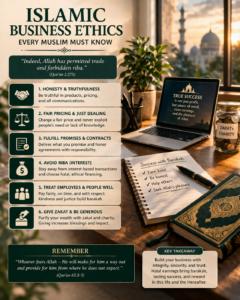
Islamic Business Ethics Every Muslim Must Know
Let’s talk openly for a moment.
Business today is fast, competitive, and sometimes… not very honest. People cut corners, hide the truth, and chase profit at any cost. And if you try to do things the right way, it can feel like you’re at a disadvantage.
So naturally, a question comes up:
Can you really succeed in business while staying true to Islamic values?
The answer is yes. Not only is it possible—it’s actually more sustainable, more respected, and more rewarding in the long run.
But it requires something many people overlook: strong ethical principles.
Islam doesn’t separate business from faith. How you earn, spend, and deal with others is part of your عبادah. It reflects your character and your relationship with Allah.
So this is not just about “rules.” It’s about building a business that has integrity, barakah, and long-term success.
Also Read: Music in Islam: What Scholars Really Say (A Balanced and Honest Guide)
Why Ethics Matter More Than Profit
Let me tell you something simple but powerful.
Profit without ethics may grow fast but it doesn’t last.
You might gain money quickly through:
- Deception
- Exploitation
- Dishonesty
But eventually, it catches up, through loss of trust, legal issues, or lack of barakah.
In Islam, success is not just about how much you earn. It’s about how you earn it.
Two people can make the same amount:
- One earns it honestly and sleeps peacefully
- The other earns it through shortcuts and lives in constant stress
Which one is truly successful?
The Foundation: Business Is an Act of Worship
This is where Islamic business ethics begin.
If your intention is correct, your work becomes worship.
That means:
- Selling a product honestly becomes عبادah
- Serving customers sincerely becomes عبادah
- Building a business with integrity becomes عبادah
But intention alone is not enough. It must be backed by action.
Principle 1: Honesty in All Dealings
This is the core of everything.
You must be honest:
- About your product
- About your service
- About your pricing
No exaggeration. No hidden defects. No misleading claims.
If there is a fault in what you’re selling, you disclose it.
Why?
Because trust is more valuable than a one-time sale.
People may forget your price—but they will never forget how you made them feel.
Principle 2: Avoiding Deception and Fraud
This goes hand in hand with honesty.
Deception can be subtle:
- Editing product images to look better than reality
- Hiding negative details
- Making false promises
Even small deception matters.
In Islamic ethics, misleading someone—even slightly—is not acceptable.
Because business is built on trust, and once trust is broken, it is hard to rebuild.
Principle 3: Fair Pricing
Islam does not fix prices—but it emphasizes fairness.
You are allowed to make profit. Islam encourages trade.
But:
- Exploiting people’s desperation
- Charging unfair prices during crises
- Taking advantage of ignorance
These go against ethical business practices.
Fair pricing builds long-term customers.
Unfair pricing brings short-term gain but long-term damage.
Principle 4: Fulfilling Promises and Contracts
If you say you will deliver something—deliver it.
If you agree on terms—honor them.
This includes:
- Deadlines
- Product quality
- Service expectations
Breaking promises might seem small, but it destroys credibility.
And credibility is everything in business.
Principle 5: Avoiding Interest (Riba)
This is one of the most serious issues in Islamic finance.
Interest-based transactions are clearly prohibited.
This includes:
- Loans with interest
- Certain financial systems built on riba
It might feel difficult to avoid—but it is essential.
Because money earned through prohibited means loses barakah.
And without barakah, growth becomes unstable.
Principle 6: Transparency in Transactions
Be clear in your dealings.
No hidden terms. No confusing conditions.
Customers should know exactly:
- What they are paying for
- What they will receive
- What the conditions are
Transparency creates confidence.
And confident customers return.
Principle 7: Respecting Employees and Workers
If you have employees or partners, how you treat them matters deeply.
You must:
- Pay them fairly
- Pay them on time
- Treat them with respect
Exploitation is not just unethical—it is ظلم.
A business built on injustice will not have lasting success.
Principle 8: Avoiding Greed
Ambition is good.
But greed is dangerous.
Greed leads to:
- Unethical shortcuts
- Stress and dissatisfaction
- Loss of moral boundaries
Islam teaches balance.
Earn well—but don’t let money control you.
Principle 9: Giving Charity (Zakat and Beyond)
One of the most powerful parts of Islamic business ethics is giving.
Zakat is obligatory.
But beyond that, voluntary charity brings:
- Barakah in wealth
- Protection from loss
- A sense of purpose
It may seem like giving reduces wealth—but in reality, it strengthens it.
Principle 10: Accountability Before Allah
This is what makes Islamic ethics different.
Even if no one sees your actions—Allah does.
This creates a higher level of responsibility.
You don’t just act ethically because of laws or reputation.
You do it because you know you will be accountable.
Real-Life Application: Bringing Ethics Into Modern Business
Let’s bring this into today’s world.
Whether you run:
- An online store
- A blog
- A service-based business
These principles still apply.
For example:
- Don’t use clickbait that misleads
- Don’t promise results you can’t deliver
- Be honest in marketing
Ethics are not outdated—they are more important than ever.
Common Mistakes Muslims Make in Business
Let’s address some real issues.
Some people:
- Justify small lies because “everyone does it”
- Ignore ethical rules when money is involved
- Separate religion from business
This is a mistake.
Your business is part of your deen.
You cannot separate the two.
Experience-Based Insight
From real observation, one thing is clear:
Businesses built on ethics:
- Grow slower at first
- But last longer
- Build stronger customer loyalty
- Face fewer crises
While unethical businesses:
- Grow fast
- But collapse quickly
Consistency beats shortcuts.
How to Build an Ethical Business Step by Step
Let’s make this practical.
Start with:
- Fix your intention
- Be honest in every interaction
- Avoid anything doubtful
- Treat people fairly
- Keep learning and improving
You don’t have to be perfect.
But you have to be sincere.
A Personal Reflection
Let me speak to you directly.
If you are building something a business, a brand, a platform ask yourself:
Would I still do this if Allah was the only one watching?
Because in reality, He is.
This mindset changes everything.
Also Read: Powerful Dua for Anxiety and Depression (Authentic Islamic Solutions)
Final Thoughts: Real Success Is Clean Success
At the end of the day, success is not just about numbers.
It’s about:
- Peace of mind
- Clean earnings
- Respect from others
- Barakah in your life
You can build something powerful without compromising your values.
In fact, that’s the only way to build something that truly lasts.
Conclusion
Islamic business ethics are not restrictions—they are protections.
They protect:
- Your reputation
- Your income
- Your hereafter
So don’t see them as limitations.
See them as a framework for real, lasting success
About The Author
