
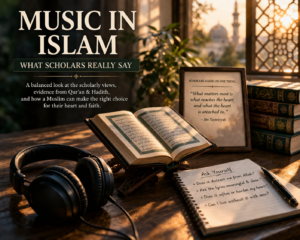
Introduction: Let’s Talk About It Honestly
Music in Islam: What Scholars Really Say (A Balanced and Honest Guide)
Let’s not pretend this isn’t a sensitive topic.
Music is everywhere on your phone, in cars, on social media, in shops. It’s part of daily life. So when someone says, “Music is haram,” it can feel confusing… even overwhelming.
Maybe you’ve asked yourself:
- Is all music really forbidden?
- What about nasheeds?
- Why do scholars disagree?
- Am I doing something wrong?
If you’ve ever felt stuck between what you enjoy and what your faith teaches, you’re not alone.
So instead of giving you a one-sided answer, let’s break this down properly, honestly, respectfully, and based on what scholars have actually said.
Why This Topic Is So Debated
Here’s the truth: this is one of those issues where scholars have differed for centuries.
And that’s important to understand.
Not every Islamic topic is black and white. Some have room for interpretation based on:
- Evidence from Qur’an and Hadith
- Context
- Understanding of scholars
Music falls into this category.
The Strong View: Music Is Not Permissible
Many classical scholars held the opinion that music with instruments is not allowed (haram).
They base this on certain hadith where musical instruments are mentioned negatively.
One commonly referenced narration mentions people who will consider:
- Alcohol
- Silk (for men)
- And musical instruments
as permissible when they are not.
Because of this, scholars like:
- Imam Ahmad ibn Hanbal
- Imam Malik (with some nuance)
- Scholars from the Hanbali and some Shafi’i traditions
leaned toward strictness regarding music.
Their Concern Was Not Just Sound
It wasn’t only about instruments, it was about what music often leads to:
- Distraction from Salah
- Emotional attachment to harmful lyrics
- Immoral environments
So their position is rooted in protecting the heart and faith.
The More Flexible View: Some Music Is Permissible
Now here’s where it gets interesting.
Other respected scholars allowed certain forms of music under conditions.
They argued:
- Not all music is harmful
- The ruling depends on content and context
Scholars in this view include:
- Imam Al-Ghazali
- Some scholars within the Maliki and Shafi’i schools
Their Reasoning
They believed:
- The Qur’an does not explicitly ban all music
- Some hadith are open to interpretation
- The effects of music depend on how it is used
So they made distinctions:
Permissible:
- Clean lyrics
- No immoral themes
- Not distracting from obligations
Not permissible:
- Vulgar or explicit content
- Music linked to sinful environments
So… Who Is Right?
This is the part people struggle with.
The honest answer is:
Both sides are trying to follow Islam sincerely.
This is not about “right vs wrong” in a simple sense—it’s about difference of scholarly interpretation.
As a Muslim, your responsibility is to:
- Learn
- Reflect
- Choose a position based on knowledge and sincerity
Let’s Bring It Down to Real Life
Let’s talk practically, like we’re sitting together.
Ask yourself:
- Does music make me miss Salah?
- Does it fill my heart more than Qur’an?
- Are the lyrics influencing my thoughts negatively?
- Do I feel closer to Allah or further away?
Your honest answers matter more than debates.
The Heart Test (Very Important)
Here’s something many people ignore:
Islam is not just about rules, it’s about the condition of your heart.
Even if something is technically allowed, ask:
- Is it benefiting me?
- Is it distracting me?
- Is it replacing something better?
Sometimes the question is not: “Is it haram?”
But: “Is it helping me grow?”
What About Nasheeds?
Nasheeds (Islamic vocal songs) are widely accepted, especially when:
- They don’t include instruments (according to stricter views)
- They have meaningful, clean messages
Even scholars who discourage music often allow:
- Voice-only nasheeds
- Duff (simple drum) in certain contexts
A Balanced Approach (Practical Advice)
Let me give you something real—not extreme.
1. Start Reducing, Not Forcing
If you listen to music regularly, don’t suddenly quit everything overnight.
Gradual change works better.
2. Replace, Don’t Just Remove
Try:
- Qur’an recitations
- Islamic lectures
- Nasheeds
3. Be Honest With Yourself
Don’t justify harmful content just because it sounds good.
4. Respect Differences
Some people avoid all music. Others take a moderate view.
Don’t judge harshly focus on your own journey.
A Personal Reflection
Let me say something that might hit home.
Many people don’t realize how much music affects them until they step away from it.
Suddenly:
- Your mind feels clearer
- Your focus improves
- Your connection with Salah gets stronger
Not because music is “evil” but because your heart has more space.
(Trust & Authenticity)
This topic requires trust and responsibility.
What you’ve read here is based on:
- Classical scholarly opinions
- Recognized differences within Islamic schools
- Balanced interpretation, not extremes
You’re not being forced into one view you’re being guided to understand the reality.
Final Thoughts: It’s Between You and Allah
At the end of the day:
This is your personal journey.
You don’t need to:
- Follow trends blindly
- Ignore your conscience
- Feel pressured by others
Instead:
- Learn sincerely
- Reflect deeply
- Make a choice that brings you closer to Allah
Because that’s the real goal.
Frequently Asked Questions (FAQs)
Is all music haram in Islam?
There is a difference of opinion. Some scholars say all instrumental music is haram, while others allow certain types depending on content and context.
Are vocals or nasheeds allowed?
Yes, most scholars allow vocals, especially if they contain clean and meaningful content without instruments.
Can I listen to music if it doesn’t affect my faith?
This depends on the scholarly opinion you follow. However, it’s important to regularly assess whether it truly has no negative effect on your heart or actions.
About The Author
